












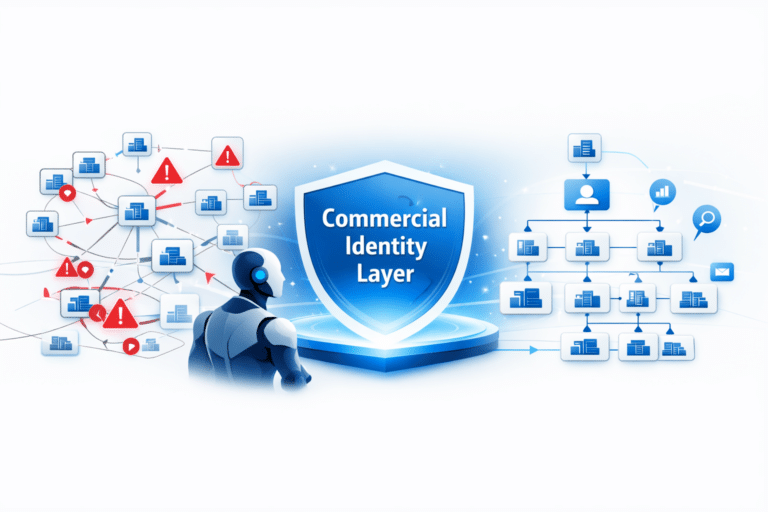
💡 What is a Commercial Identity Layer?
A Commercial Identity Layer is a structured map of B2B account relationships that translates raw CRM data into an operational model for AI execution. Unlike standard legal hierarchies, it defines buying centers and influence paths, preventing “structural hallucinations” where AI agents misidentify global customers as isolated, low-value leads.
The market has moved past “AI Copilots.” We are no longer just asking AI to summarize a call or draft an email. We are entering the era of AI Agents—autonomous systems that qualify leads, route inquiries, and orchestrate global GTM motions.
But there is a wall looming for enterprise teams.
Most companies are deploying sophisticated AI on a CRM foundation that doesn’t reflect commercial reality. When your account structure is fragmented, your AI isn’t just working with “messy data”—it’s operating on a broken map.
This is the AI Readiness Gap. If your hierarchy is broken, your AI will make the wrong decisions at a scale and speed you cannot manually correct.
The Rise of “Structural Hallucination”
In the LLM world, a hallucination is a factual error. In the GTM world, the new threat is Structural Hallucination.
This occurs when an AI Agent isn’t wrong because it lacked intelligence, but because it lacked Commercial Identity.
- The Scenario: An AI Agent receives an inquiry from a small subsidiary. It sees no history in the CRM and classifies it as a “Low-Value Cold Lead.”
- The Reality: That subsidiary is owned by your largest Global Parent. There is a $2M expansion deal currently in negotiation at the HQ level.
The AI didn’t “fail.” It followed the data. But because the hierarchy didn’t link the two, the AI just committed a high-speed error that could cost a major relationship.
Legal Parent vs. Commercial Identity
Most CRMs are built for reporting (Who do we bill?). AI requires a structure built for execution (How do we sell?).
| Feature | Legal Parent (Standard) | Commercial Identity (AI-Ready) |
|---|---|---|
| Primary Goal | Tax & Compliance | GTM Strategy & Automation |
| Logic | Static ownership | Real-world buying centers |
| AI Value | Low (Confuses routing) | High (Enables autonomy) |
| Outcome | Accurate Billing | Identified Whitespace |
The bottom line: Legal structure tells you who owns the business. Commercial Identity tells an AI Agent how to treat them. Finance vs. Sales Hierarchy Conflict
Three Areas Where Broken Hierarchies Break AI Agents
1. Lead-to-Account (L2A) Matching
If a lead from a subsidiary isn’t automatically matched to the Global Parent via a clean hierarchy, your AI-powered routing will fail. It will treat expansion opportunities like net-new prospecting, leading to duplicate outreach and broken Rules of Engagement (RoE). You need automatic territory management and account linking.
2. Contextual Account Scoring
AI scoring models only work when they can aggregate signals. If product usage is on Record A, intent signals are on Record B, and historical spend is on Record C, the AI sees three “weak” accounts instead of one “powerhouse” customer group.
3. Automated Whitespace Discovery
This is the “Holy Grail” of AI GTM. An agent should be able to say: “We sold to the UK branch; we should now pitch the French branch.” But if those entities aren’t linked, the AI is blind to the connection. No hierarchy, no whitespace.
The Missing “Middle Layer” in your GTM Stack
Most teams think of their stack in two layers:
- The System of Record: (CRM, Marketing Automation)
- The AI Layer: (Agents, Copilots, Scoring)
What’s missing is the Commercial Identity Layer. This is the “decision engine” that sits between your raw data and your AI. It tells the AI which records belong together, which parent drives the strategy, and which relationships actually matter for revenue.
AI Readiness Checklist: Is Your Map Accurate?
Before you deploy Agentforce or any autonomous SDR tool, ask these four questions:
- Signal Aggregation: Can our AI see the total footprint of a customer across all subsidiaries?
- Routing Logic: Can our system distinguish between a “Legal Parent” and a “Commercial Parent” for territory assignment?
- Ownership Clarity: Can the AI resolve conflicting ownership across a global group?
- Automation Speed: Is our hierarchy updated in real-time, or does it wait for a manual quarterly cleanup?
Conclusion: Don’t Build on a Swamp
You cannot build an autonomous GTM organization on a fractured account table. Account hierarchy is no longer a “back-office cleanup task”—it is the foundational infrastructure for the AI era.
The companies that build a true Commercial Identity Layer will see their AI Agents thrive. The companies that ignore it will simply automate their mistakes at a faster rate.
Is your CRM map holding back your AI ambition?
Get a Delpha Account Hierarchy Audit