













Congratulations! Your company is booming. You’re expanding globally, hiring rockstar sales teams in Tokyo, London, and NYC. You’re probably popping champagne and dreaming of that Series D. But guess what? While you’re celebrating, there’s a sneaky little thing called the “Global Scale-Up Tax” quietly siphoning money from your revenue.
It’s not from the government. It’s from your own CRM. Specifically, your Salesforce data quality when you scale too fast without a plan. And trust us, this tax collector doesn’t take kindly to excuses. Gartner research reveals poor data quality costs organizations an average of $12.9 million per year across all industries.
What IS the Global Scale-Up Tax? (And How Do You Know If You’re Paying It?)
Imagine your global expansion is a massive party. Everyone’s invited, but nobody knows who brought the dips, who’s responsible for the music, or if three people brought the exact same brand of lukewarm beer. That’s your CRM without proper Account Hierarchy and Salesforce data management.
The Global Scale-Up Tax is the hidden operational cost your company incurs when your internal systems can’t keep pace with your external growth. It manifests in three hilarious (but costly) ways:
1. The “Who Owns This?!” Territory Tug-of-War (The Sales Team Scrum)
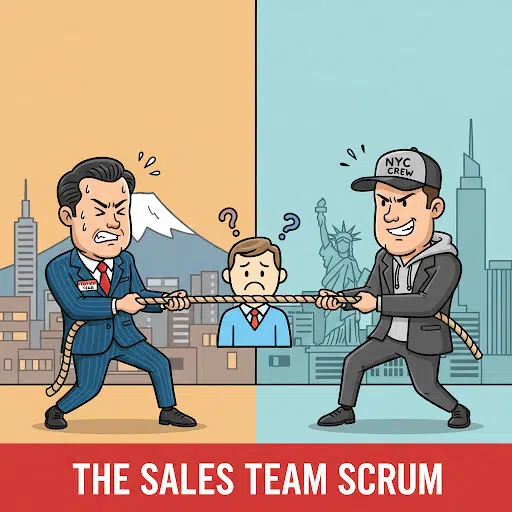
Your London rep just landed a killer meeting with Siemens UK. Awesome! Meanwhile, your New York AE is in deep discussions with Siemens AG. But wait… are these linked in Salesforce? Probably not.
The Tax: Your reps waste hours fighting over who gets the commission, the customer gets confused with duplicate outreach, and you look utterly disorganized. You’re effectively paying two people to chase one opportunity. Ouch.
2. The “Blind CEO” Syndrome (Missing the Big Picture)
You’re reporting fantastic numbers, but your CEO suddenly asks, “What’s our total revenue from General Electric globally?” You freeze. Because while you have 27 separate accounts in Salesforce (GE Healthcare, GE Aviation, GE Renewables), they’re all just… floating. Unlinked.
The Tax: You’re missing massive upsell opportunities because you don’t see the true “wallet share” of your biggest clients. You’re leaving money on the table that’s rightfully yours!
3. The Lead Routing Rollercoaster (Sending Hot Leads to the Cold Storage)

Your marketing team just spent a fortune on a killer campaign targeting Sony subsidiaries in Europe. A hot lead from Sony Spain comes in, but because it’s not linked to the main “Sony Corp” parent account in Salesforce, it gets routed to the wrong regional AE, or worse, into a generic “Rest of World” queue.
The Tax: Hot leads go cold. Marketing ROI plummets. Your RevOps team spends more time playing detective than optimizing processes.
How to Repeal the Global Scale-Up Tax (Get Your Money Back!)
The good news? You don’t need a politician to repeal this tax. You just need better Salesforce data automation.
Tools like Delpha act as your personal data sheriff, automatically:
- Mapping Account Hierarchies: They intelligently connect “Sony Spain” to “Sony Corp,” giving you a 360-degree view of every global client. No more manual linking!
- Deduplicating Across Regions: Stop the territory wars before they start by ensuring only one team works a single account, no matter where the subsidiary pops up.
- Fueling Your AI: If you’re building awesome AI-powered tools (like ElevenLabs’ ElevenAgents or Salesforce’ Sales Agents), you need pristine data. Garbage In, Garbage Out still applies, even to your smartest AI.
Investing in Salesforce data quality isn’t just about cleaning up messes; it’s about enabling your hyper-growth without the hidden tax penalties. It ensures your global expansion is truly efficient, your sales teams are happy, and your leadership has the accurate insights they need.
Stop paying the Global Scale-Up Tax! Invest in smart Salesforce data management and keep more of the revenue you’re working so hard to earn.
Improve efficiency and boost revenue with Delpha
Want to learn more about Delpha?