











Running a hybrid growth model is the holy grail of modern B2B SaaS. You get the scalable “land” of Product-Led Growth (PLG), combined with the high-revenue “expand” of a Sales-Led enterprise motion. We often call this Product-Led Sales.
In theory, it’s beautiful: individual users discover your product (the bottom-up entry), and your enterprise reps close the massive corporate deal (the top-down execution).
In reality, most hybrid models are broken. And they are broken by a data architecture problem that RevOps teams have ignored for too long.
We are talking about account hierarchy.
Here is why your hybrid growth motion—which depends on capturing “hidden” enterprise revenue—is dead on arrival if your CRM doesn’t have a clean, hierarchical view of your customers.
The PLG vs. Sales-Led Crisis: Why They Crash and Burn
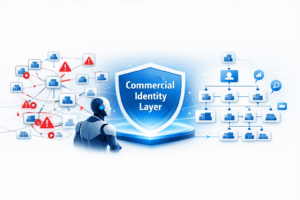
Let’s visualize the “Frankenstein” data you’re likely working with right now:
- The PLG View: You have 1,000 users with different emails (e.g.,
@design.microsoft.com,@berlin.microsoft.com). Your data matching rules likely treat these as 1,000 individual, low-intent “small leads.” - The Sales-Led View: A Strategic Account Executive is trying to break into “Microsoft.” They are cold-calling a Director in Seattle, unaware that 1,000 users are already paying $10/month on credit cards across the globe.
This is not a “people problem.” It is a relationship intelligence problem. If the system doesn’t understand that @design.microsoft.com is a subsidiary or branch of the Ultimate Parent, you have a siloed business, not a hybrid one. This misalignment isn’t just a CRM quirk; according to Gartner’s 2026 strategic technology trends, the inability to unify customer data is the primary reason hybrid growth models fail to scale.
The Interest in a Hierarchical Bridge: Three Critical Benefits
When you build a hierarchical “bridge” between your PLG data and your Sales-Led CRM, you unlock three game-changing strategic advantages:
1. Uncovering “Hidden” Enterprise Revenue: The “Roll-up”
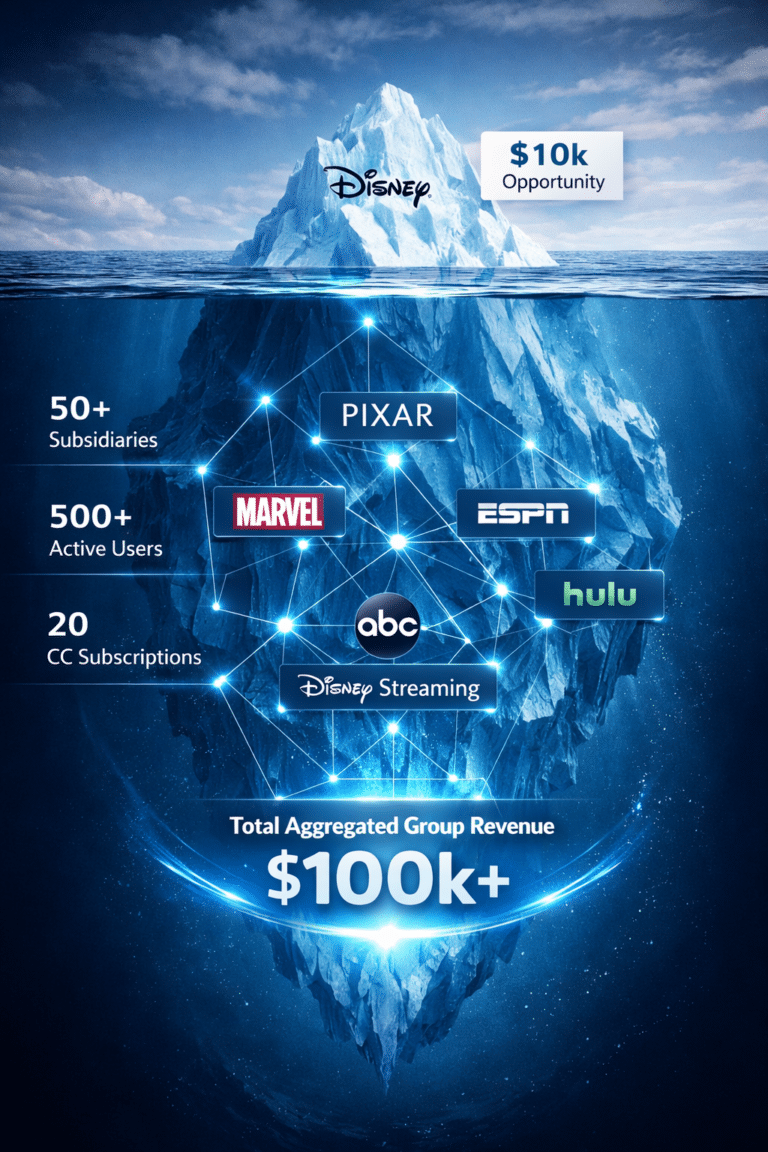
A high-quality account hierarchy consolidates all your unmanaged PLG usage. When you sum up the active users and the total credit card spend across 50 different “records,” you suddenly realize you have a massive, unmanaged footprint inside a Global 2000 company.
This is how you move from selling a fragmented $50/month transaction to a consolidated, secure $250k/year Master Service Agreement (MSA). You have the data to prove that they are already “addicted” to your tool.
2. Mastering “Land and Expand” (Strategic Account Planning)
Hybrid growth is built on the “Land and Expand” framework.
- The Land: PLG gets you in the door at Subsidiary A.
- The Expand: Your enterprise sales team uses the hierarchy to proactively identify all the other subsidiaries and parent organizations within that same corporate family tree.
If your designers in Berlin (PLG) are happy, the hierarchy tells you exactly where to target your next Sales-Led pitch (e.g., the parent organization’s global procurement lead). It transforms expansion from accidental to predictive.
While the Product-Led Growth Index benchmarks show that PLG companies scale faster, they often hit a revenue ceiling without a structured way to transition into enterprise sales. Modern enterprise sales reps must adapt to the fact that buyers are already using the product —a shift backed by McKinsey’s research on omnichannel B2B buying behavior— making account hierarchy the only way to track that ‘invisible’ influence.
3. Efficient Lead Routing (PQL vs. SAL)
Your most expensive assets are your Strategic Account Managers (SAMs). You cannot afford to have them waste time calling the wrong leads.
A hierarchical view allows for efficient, logic-based lead routing:
- The Filter: If a new user signs up from a small business or a “dead-end” subsidiary (no other known parents/children), keep them in the PLG (self-serve) lane.
- The Route: If a new user signs up from a known Global Ultimate Parent or a high-potential subsidiary (e.g., Instagram), route them immediately to a SAM as a Product Qualified Lead (PQL). They are now an inside track to a global deal.
Summary Table: PLG + Sales-Led with Hierarchy
| Feature | Without Account Hierarchy | With Account Hierarchy (Hybrid Success) |
|---|---|---|
| Sales Pitch | Cold / Wasted | “Informed” (using internal usage as leverage) |
| Revenue Model | Fragmented Transactions | Consolidated Enterprise contracts |
| Customer Experience | Billing friction and duplicated outreach | Unified “Strategic Partner” experience |
| Expansion Strategy | Accidental / Reactive | Strategic / Predictive “Land & Expand” |
The Bottom Line: Your CRM is Your Strategic Referee
In the age of AI Data Stewards and complex corporate archetype puzzles (Holding Shells, Joint Ventures, Franchises), relying on messy, flat data is not an option.
Account hierarchy is the OS of a Product-Led Sales model. If the OS is buggy, your “revenue apps” (PQLs, Territory Plans, MSAs) will crash. Fix your data foundation now, or get ready to fight internal fires in 2026.
Download our 2026 Guide to Salesforce Ultimate Parent logic to share with your RevOps team.
Get the Cheat Sheet